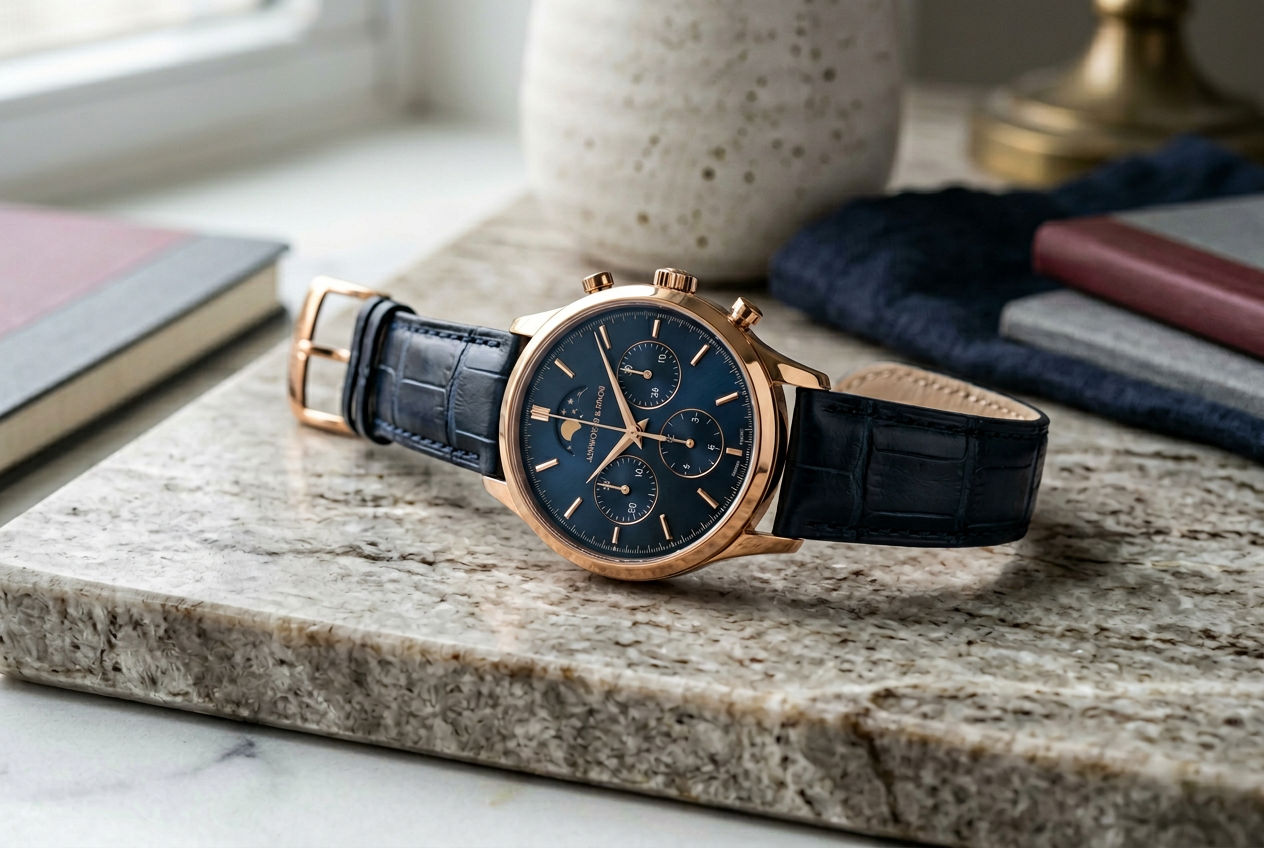
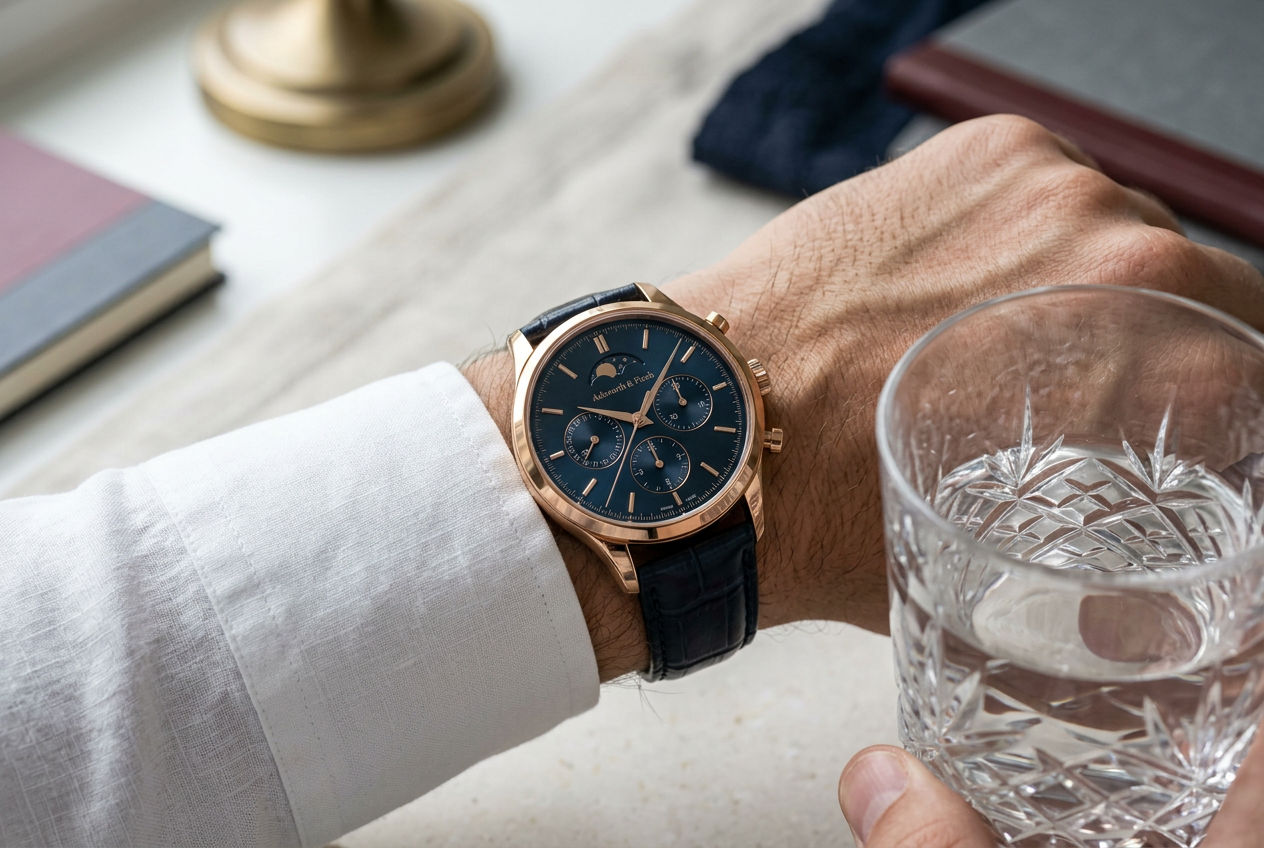
The Langdon Perpetual Calendar
- Case
- 39mm , 10.8mm thick
- Dial
- Deep midnight blue with a very fine sunray radiating from centre — quieter than the Hampstead Blue fumé, more formal. Applied 5N rose gold (or white gold, for platinum case) hour indices. Three subsidiary dials in a triangular arrangement: day at 9 o'clock, month at 3, retrograde date along the bottom arc from 8 to 4. Peripheral moon phase integrated into the dial at 12 — a small window showing a deep-blue sky and a 5N or white-gold moon, with a twin correction cycle of 122.6 years before adjustment is theoretically required. Leap year indicator at the intersection of the month register.
- Movement
- A&F calibre HF-801 (Sellita SW300-1 (thin automatic) with a Dubois-Dépraz 5100 perpetual calendar module, substantially modified and hand-finished in Southampton to A&F specification. The modifications include a revised setting cam to unify the corrector pusher operation and a custom moon disc. )
- Power reserve
- 42 hours
- Water resistance
- 30m
- Crystal
- Domed sapphire, double internal anti-reflective coating
- Strap
- Hand-stitched navy alligator (rose gold variant) or anthracite alligator (platinum variant), 19mm, signed solid-gold or solid-platinum pin buckle (matching the case).
Heritage
The Perpetual Calendar is the piece that Harold said, in 2019, he would not make for "at least five years." It arrived in 2024 — five and a half years after founding the brand — and represents the ceiling of what A&F will attempt in the current decade. Harold has been clear that there will be no grand complications beyond the perpetual until the current programme is established over several more years of output. The two case variants are not a marketing choice. Rose gold is the traditional British dress-watch case material (Harold's grandfather wore rose gold). Platinum was added reluctantly, after two existing clients made strong cases for it.
Design
Perpetual calendars are usually designed by accretion — each indicator added where there is room. Harold's brief was the opposite: start with the cleanest possible dress dial and add only what absolutely must be there. The retrograde date (rather than a pointer or subdial) was chosen because it is the least visually intrusive way to show date while keeping the lower half of the dial legible. The peripheral moon phase (rather than a subdial moon) is the piece's most unusual choice — peripheral moons are technically difficult and usually sit on more expensive pieces than the Langdon Perpetual. Harold felt the dial balance required it.